SEC Stablecoin Approval: 5 Key Regulatory Drivers
of stablecoins under U.S. federal securities law has shifted from interpretive ambiguity to codified exclusion.
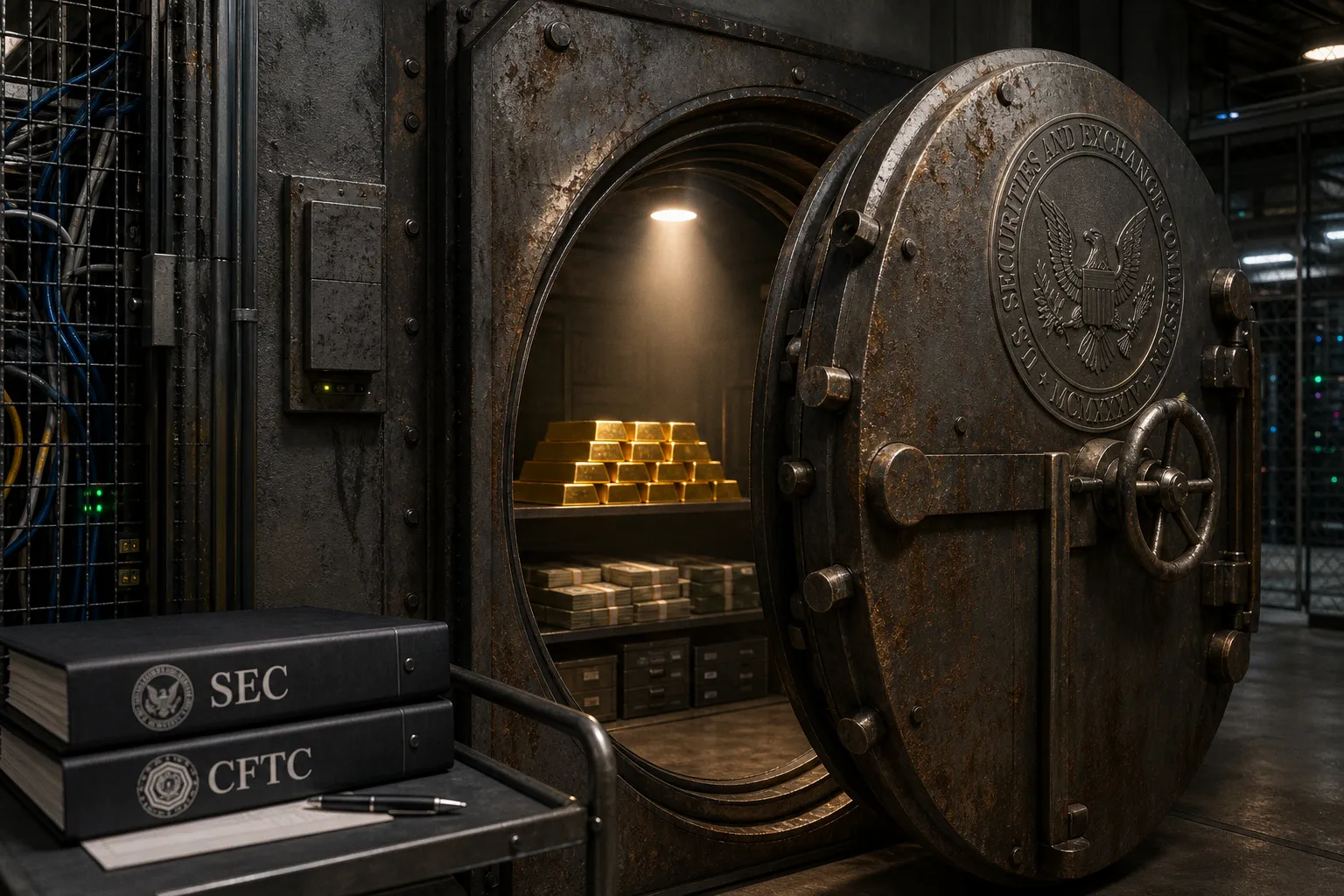
Between April 2025 and March 2026, a sequence of legislative and regulatory actions effectively closed the loop on whether compliant payment stablecoins qualify as securities. The mechanism is no longer a question of agency enforcement discretion; it operates through statutory text, interpretive releases, and explicit procedural requirements for issuers and intermediaries. For compliance teams, treasury operations, and legal counsel working with payment stablecoins, this is the systems-level question worth tracing: how does a digital asset move from an ambiguous status under the Howey and Reves tests to a defined carve-out, and what engineering constraints does that carve-out impose on the issuer's balance sheet, custody arrangement, and redemption logic?
The GENIUS Act: Establishing the Federal Regulatory Perimeter
The Guiding and Establishing National Innovation for U.S. Stablecoins Act (GENIUS Act) was signed into law on July 18, 2025. It defines a federal perimeter for "payment stablecoins" and assigns issuance authority to a narrow class of entities called permitted payment stablecoin issuers (PPSIs).
The statute accomplishes three mechanical operations simultaneously. First, it defines the asset class. A payment stablecoin is a digital asset used as a means of payment or settlement, pegged to a fixed value, redeemable on demand at par by the issuer, and backed by specified reserve assets. Second, it defines the issuer. A PPSI is either a subsidiary of an insured depository institution, a federal qualified issuer chartered by the OCC, or a state qualified issuer operating under a state regulatory framework (available to issuers with less than $10 billion in outstanding stablecoins). Third, it excludes the asset from securities and commodities law. Stablecoins issued by a PPSI are explicitly carved out from the definitions of "security" and "commodity" under the relevant federal statutes, removing them from SEC and CFTC jurisdiction by operation of law rather than by enforcement choice.
The GENIUS Act does not regulate payment stablecoins as securities; it removes them from the jurisdiction that would treat them as such.
The structural consequence is significant. Issuers that fall outside the PPSI classification, including foreign issuers operating in U.S. markets without a federal or state charter, cannot rely on the same exclusion. Their products remain subject to the existing analytical framework under federal securities law, including the investment contract analysis articulated in SEC v. W.J. Howey Co. and the debt-instrument analysis articulated in Reves v. Ernst & Young. The statute narrows the issuance pathway but converts compliance into a checklist rather than a litigation risk. The shift from "we will tell you if you are compliant" to "here is the closed set of requirements, meet them and the question is settled" is the most consequential change in the post-2025 stablecoin regulatory architecture.
Decoding the SEC's 2025 Statement on Covered Stablecoins
On April 4, 2025, three months before the GENIUS Act became law, the SEC's Division of Corporation Finance issued a Statement on Stablecoins. The document introduced the term "Covered Stablecoin" and articulated the criteria under which a stablecoin falls outside securities regulation under existing doctrine, without requiring new statutory authority.
A Covered Stablecoin, as defined in the statement, must satisfy a closed set of mechanical conditions:
- Denominated in U.S. dollars, redeemable on demand at a fixed 1:1 ratio.
- Backed by low-risk liquid assets with a market value at least equal to the par value of outstanding stablecoins.
- Reserves not commingled with the issuer's general corporate funds.
- No payment of yield or interest to holders from the issuer.
- Compliance with applicable anti-money laundering and sanctions obligations.
The analysis is structured around the Howey and Reves tests. Under Howey, the absence of a profit expectation removes the asset from investment contract analysis: a holder is not led to expect returns derived from the efforts of others, only par redemption on demand. The four prongs of Howey, (1) investment of money, (2) in a common enterprise, (3) with a reasonable expectation of profits, (4) to be derived from the entrepreneurial or managerial efforts of others, must each be satisfied for a transaction to be an investment contract. The Covered Stablecoin structure is engineered to defeat prongs three and four by design: the holder's expectation is anchored to dollar parity, not to appreciation or yield generated by issuer efforts. Under Reves, the absence of debt-like characteristics (no fixed maturity, no interest payments to holders, no issuer promise of returns beyond par) supports the conclusion that the instrument is not a note. The combined effect is that a Covered Stablecoin functions as a payment instrument with a redemption right, not as a security.
A Covered Stablecoin is engineered to fail every prong of the Howey test by design, not by regulatory waiver.
The April 2025 statement did not "approve" any specific stablecoin product. It established a definitional framework. Issuers whose products meet the criteria are excluded from securities regulation; issuers whose products deviate from the criteria, including those that pay yield, use algorithmic stabilization, or back the token with non-USD assets, remain subject to the standard analytical process. The statement also clarifies that the analysis applies to the token itself, not to secondary market activity: trading platforms that list Covered Stablecoins do not become securities exchanges solely by virtue of listing an excluded asset, though they remain subject to general anti-fraud and market integrity rules.
Joint SEC-CFTC Interpretive Release: Defining Non-Security Status
On March 17, 2026, the SEC and CFTC issued a joint interpretive release that consolidated the position articulated in the April 2025 statement and aligned it with the statutory framework established by the GENIUS Act. The release affirms that the offer and sale of Covered Stablecoins, as defined under SEC guidance, do not involve the offer and sale of securities under Section 2(a)(1) of the Securities Act of 1933.
The release performs a coordination function. Prior to 2025, the question of whether a stablecoin was a security (under SEC jurisdiction) or a commodity (under CFTC jurisdiction) created an enforcement overhang for issuers. The two agencies' jurisdictional claims overlapped in practice: a stablecoin could simultaneously be analyzed under SEC investment contract doctrine and CFTC commodity derivatives frameworks, leaving issuers exposed to dual regulatory pressure. The joint release, combined with the GENIUS Act's exclusion language, closes that gap for compliant products: compliant payment stablecoins are excluded from SEC classification as securities and from CFTC classification as commodities. Their primary oversight falls to banking regulators under the new framework, with the OCC, the Federal Reserve, and state banking supervisors holding direct supervisory authority over PPSIs.
The mechanics remain constrained to a specific asset configuration. Stablecoins that pay yield to holders, rely on algorithmic stabilization mechanisms, or are backed by non-USD-denominated assets remain outside the Covered Stablecoin classification. Those products are not addressed by the March 2026 release and continue to be evaluated under existing securities and derivatives frameworks. The interpretive release also clarifies the boundary between GENIUS Act-covered payment stablecoins and other digital assets; it does not generalize a non-security finding to the broader crypto asset class. Algorithmic stablecoins, yield-bearing synthetic dollars, and tokenized money market fund shares remain in the regulatory gray zone they occupied before 2025; the release does not resolve their status.
Reserve Custody and the Prohibition of Rehypothecation
The exclusion from securities law is contingent on a strict reserve custody regime. This is the operational core of the framework and the most consequential constraint placed on issuers.
Under the SEC's 2025 statement and the GENIUS Act's implementing requirements, reserve assets backing a Covered Stablecoin or payment stablecoin must not be commingled with the issuer's general operating funds. They must not be lent, pledged, rehypothecated, or otherwise encumbered. The reserves must be held in a custody arrangement that shields them from third-party claims, including claims by the issuer's other creditors in an insolvency proceeding.
The engineering logic is that reserve integrity produces the redemption guarantee. If reserves can be rehypothecated, the 1:1 backing is no longer a static balance sheet claim; it becomes a fractional claim on assets that may have been deployed elsewhere. The redemption mechanism, the function by which a holder exchanges one stablecoin for one U.S. dollar, depends on the reserves being available and unencumbered at the moment of redemption. If the issuer has pledged those reserves as collateral for its own borrowing, the holder's claim sits behind the lender's claim in any recovery waterfall. The prohibition on rehypothecation is therefore not a stylistic preference; it is a precondition for the redemption promise to function as described in the offering.
| Custody Requirement | Operational Constraint | Failure Mode |
|---|---|---|
| No commingling | Reserves held in segregated accounts | Loss of par-value claim in issuer insolvency |
| No rehypothecation | Reserves cannot be lent or pledged | Effective fractional reserve if deployed |
| No third-party encumbrance | Reserves immune to issuer creditor claims | Competing claims reduce redemption capacity |
| Periodic attestation | Independent verification of reserve composition | Information asymmetry between issuer and holder |
The attestation requirement introduces a reporting cadence. Issuers must publish regular disclosures, and depending on size and charter type, may be required to obtain full reserve audits from independent registered accounting firms. The attestation is not a one-time compliance event; it is a continuous disclosure obligation. For PPSIs with more than $10 billion in outstanding stablecoins, the federal qualified issuer framework requires monthly attestations; state qualified issuers operate under state-level cadences that the relevant state banking supervisor must align with the federal minimum. The OCC issued a Notice of Proposed Rulemaking on February 25, 2026, addressing how non-bank federal qualified issuers will satisfy these requirements under 12 CFR 3, 12 CFR 6, 12 CFR 8, and 12 CFR 19. The proposed framework adapts bank capital, liquidity, and governance rules to a non-depository entity engaged in stablecoin issuance, an arrangement without direct historical precedent in U.S. banking regulation.
The integrity of any on-chain reserve verification also depends on the reliability of the off-chain data sources feeding into disclosure systems. Price feeds, custody confirmations, and reserve composition attestations increasingly rely on infrastructure that bridges off-chain financial data to on-chain verification for real-time reporting. Without accurate inputs, the segregated reserve model becomes a compliance fiction rather than an enforceable constraint.
The 2028 Deadline: Compliance Requirements for Digital Asset Intermediaries
The GENIUS Act sets a hard compliance deadline for digital asset service providers operating in the U.S. market. Beginning July 18, 2028, no digital asset service provider may offer or sell a payment stablecoin unless it was issued by a PPSI.
The deadline creates a cascading compliance requirement across the intermediary layer. Exchanges, custodians, broker-dealers, and wallet providers that facilitate stablecoin transactions must either restrict their offerings to PPSI-issued stablecoins or cease offering non-compliant stablecoins to U.S. customers. The mechanics of compliance involve customer onboarding, transaction screening, product line review, and contractual renegotiation with issuer partners. For a trading platform that currently lists multiple stablecoins, the operational work is not limited to delisting announcements; it includes wallet integration changes, liquidity pool migrations, market-maker coordination, and the technical work of distinguishing PPSI-issued tokens from non-compliant tokens within the same wallet infrastructure.
For foreign issuers operating outside the PPSI framework, the deadline functions as a market access constraint. U.S. intermediaries cannot offer their products after July 18, 2028, which effectively segments the U.S. institutional market from foreign-issued stablecoins that do not meet the domestic compliance threshold. The specific adaptation paths for non-U.S. issuers remain unconfirmed: foreign stablecoin issuers could pursue a U.S. federal charter through a subsidiary, align with a state qualified issuer framework, or accept exclusion from the U.S. institutional flow. Each path involves different cost structures, regulatory exposure, and time horizons. Pursuing an OCC charter requires demonstrating capital adequacy, governance fitness, and operational readiness under a bank-supervisory framework; pursuing a state qualified issuer framework requires navigating state-by-state variation in regulatory requirements and operating under the $10 billion issuance cap; accepting exclusion means giving up the U.S. institutional market and serving only offshore and retail customers through non-U.S. venues.
| Compliance Pathway | Mechanism | Cost Structure |
|---|---|---|
| Federal qualified issuer (OCC charter) | Apply for national bank trust charter or similar OCC-supervised entity | High regulatory overhead, federal supervision |
| State qualified issuer | Operate under state regulatory framework with $10B issuance cap | Lower initial overhead, state-level supervision |
| Subsidiary of insured depository institution | Issue through bank subsidiary | Access to bank capital and custody infrastructure |
| Non-U.S. issuer, no U.S. charter | Continue offshore operation; lose U.S. intermediary distribution | Market segmentation from U.S. institutional flow |
The PPSI framework narrows the issuance pathway but increases the durability of the compliant product. Issuers operating under federal or state qualified issuer status gain a regulatory identity that operates across multiple enforcement scenarios: compliant payment stablecoins are excluded from SEC classification as securities and from CFTC classification as commodities, and remain subject to banking-regulator oversight and reserve requirements. The capital buffer requirements that will be finalized under OCC rulemaking remain an open variable, and the timing of the first federal charter issuances is not yet established. For incumbent issuers already operating under bank-supervisory frameworks, the GENIUS Act converts an existing compliance posture into a codified market access right; for non-incumbent issuers, the Act creates a regulatory pathway that did not previously exist.
Theoretical Limits and Stress-Test Vulnerabilities
The framework is mechanically coherent under stable conditions. The stress-test scenarios are bank-run dynamics combined with reserve depreciation.
If redemptions accelerate faster than the issuer can liquidate reserves, even a 1:1 backing ratio produces a queue. Reserves held in U.S. Treasury bills, the dominant reserve asset for compliant issuers, are highly liquid under normal market conditions. Under stress, however, Treasury market dislocation could impair the mark-to-market value of reserves during the liquidation window. The peg mechanism is robust to individual redemption requests; it is less robust to simultaneous, system-wide redemption pressure combined with reserve asset volatility. A coordinated redemption event, whether triggered by counterparty failure, market rumor, or a correlated shock to short-term Treasury markets, would test the redemption queue at the exact moment when the issuer's liquidation capacity is most constrained. The historical precedent is the money market fund industry during the March 2020 Treasury market dislocation, when even high-quality short-duration portfolios experienced redemption queues and emergency liquidity facilities were required. The GENIUS Act does not create an analogous backstop facility for stablecoin issuers.
A second stress vector is the foreign issuer segmentation. If U.S. intermediaries delist non-PPSI stablecoins by July 18, 2028, and offshore liquidity for those assets fragments, the redemption path for non-U.S. holders becomes longer and more expensive. The peg holds in theory; it degrades in execution under cross-jurisdictional friction. Holders seeking to exit a non-compliant stablecoin after the deadline would face compressed liquidity in offshore venues, wider bid-ask spreads, and the operational cost of moving value across fragmented trading venues.
The framework also produces a regulatory concentration effect. By limiting issuance to PPSIs and requiring institutional charter, the law favors incumbents with existing banking infrastructure. New entrants face higher barriers to entry, and the compliant stablecoin market trends toward an oligopoly of bank-issued and large fintech-issued products. Competition migrates from protocol design to distribution agreements and reserve yield capture by the issuer entity itself, since yield cannot flow to the token holder. The economic value of the stablecoin business shifts from token-holder-facing features to issuer-level reserve management, treasury operations, and the fee structure that captures the spread between reserve yield and the issuer's operating margin.
The GENIUS Act solves the securities law question by exporting it to banking regulators, where the engineering constraints are tighter and the supervisory perimeter is narrower.
The closed system has been defined. The remaining variables are capital buffer finalization by the OCC, the timing of the first federal charter issuances, and the adaptation choices made by non-U.S. issuers as the 2028 deadline approaches. Those are execution parameters, not structural unknowns. The classification of compliant payment stablecoins under U.S. federal law has been settled; the engineering of how issuers meet the standards, and how regulators supervise them in real time, is the open operational question that will determine whether the framework holds under its first real stress event.