USD1 Stablecoin: Why Its Market Cap Is Expanding
The USD1 stablecoin crossed a $5 billion market capitalization in January 2026, less than a year after its March 2025 launch. That is a fast scale-up by any fiat-backed token standard.
But the growth was not driven by a broad retail migration into a new digital dollar. It was driven by a small number of high-volume distribution events: a $2 billion institutional settlement, Binance-led yield incentives, and deeper integration into cross-chain DeFi rails.
For banks, payment firms, and stablecoin issuers, USD1 is a useful case study in how market capitalization can expand before a token develops evenly distributed transactional use. Supply growth reflects demand for settlement inventory, exchange balances, collateral, and yield-program participation. Those are adjacent to payments, but they are not interchangeable with daily merchant acquisition or broad cross-border remittance activity.
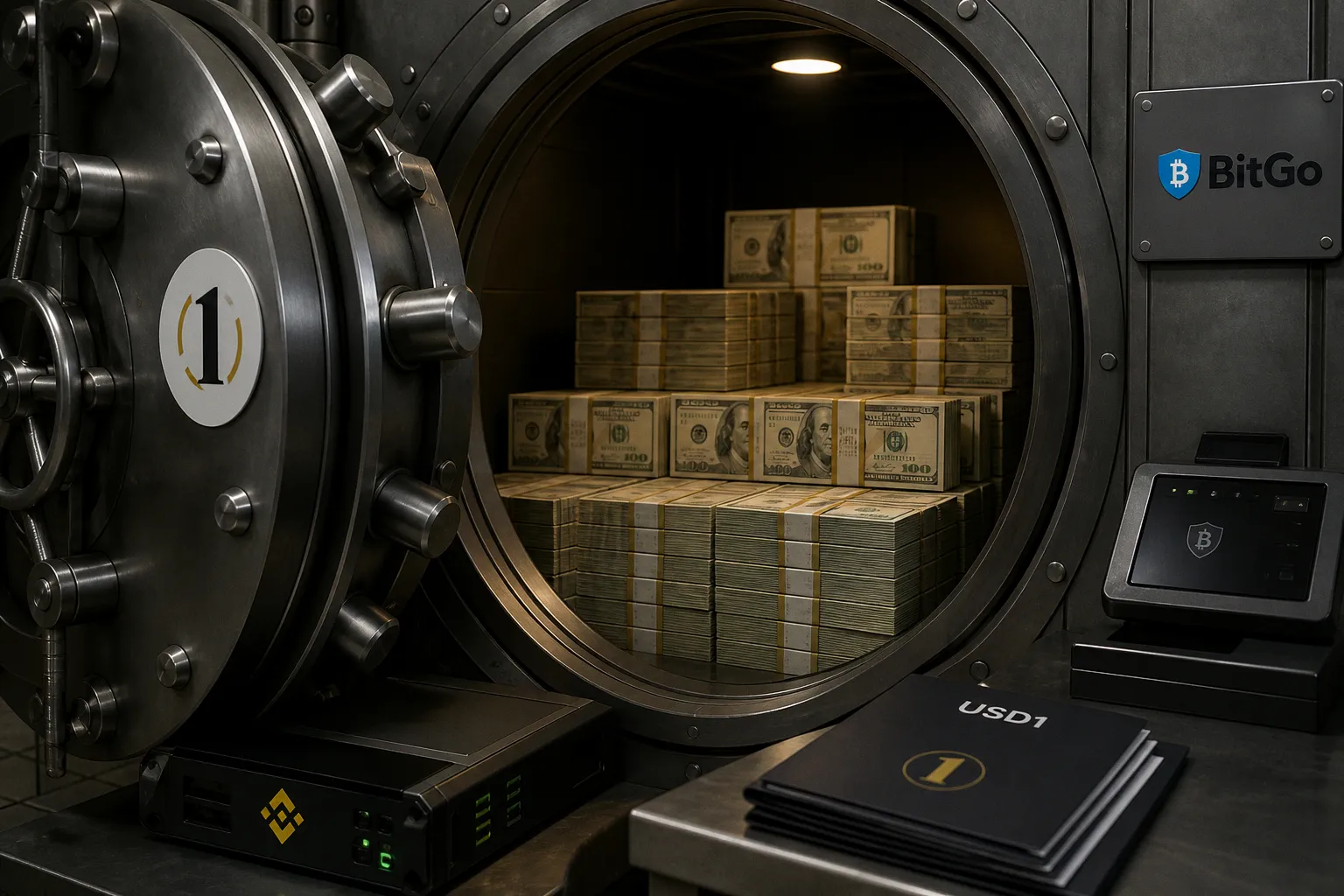
USD1 is associated with World Liberty Financial, the Trump family-linked crypto venture. Its regulated custody, minting, and issuance functions are handled by BitGo. The token is designed to maintain a 1:1 peg with the U.S. dollar.
From launch to $5 billion: a distribution-led expansion
USD1 entered the market in March 2025. Its initial scale was modest. The decisive inflection point arrived in May, when Abu Dhabi state-backed technology investor MGX used USD1 to settle a $2 billion investment in Binance.
The transaction changed the token’s balance-sheet profile in one move. USD1’s market cap rose from roughly $128 million to more than $2.1 billion in a single week. That increase was not a gradual reflection of organic trading volume. It was the direct result of one institutional transaction requiring a large stablecoin position on a defined settlement rail.
That distinction matters.
A stablecoin’s market capitalization is the value of outstanding tokens. It is not a direct measure of payment throughput, merchant acceptance, or the number of active corporate users. For an issuer and its distribution partners, however, a large settlement creates immediate operational benefits:
- It establishes liquidity at a scale that market makers and exchanges can support.
- It creates a visible inventory base for spot trading, collateral use, and Earn products.
- It reduces the perception that a token is too small for institutional treasury movement.
- It gives counterparties a reason to build custody, conversion, and transfer workflows around the asset.
The USD1 stablecoin market cap therefore tells two stories at once. It signals a successful liquidity event. It also signals that a large portion of supply can be linked to a small number of venues and counterparties.
A stablecoin can reach institutional scale through one settlement event. Building durable settlement utility requires repeated circulation after that event.
The subsequent move above $5 billion in January 2026 confirms that the May transaction was not the token’s only source of expansion. Yet the structure of that growth remains central: USD1 has been scaled through distribution concentration, rather than through the slower route of geographically dispersed payment adoption.
The MGX-Binance settlement created immediate settlement inventory
The MGX investment is the clearest example of USD1 functioning as institutional settlement infrastructure rather than a retail trading instrument. A $2 billion transaction settled in stablecoins removes several layers of traditional cross-border friction: correspondent banking timing, cut-off windows, intermediary reconciliation, and pre-funded fiat accounts across multiple jurisdictions.
For a transaction of that size, the relevant question is not whether a stablecoin is conceptually superior to bank money. The question is whether all parties can move value, receive final confirmation, manage custody, and convert or retain the resulting balance without creating unacceptable operational risk.
USD1 had the necessary advantage in this case: Binance was directly involved in the transaction and could provide a natural liquidity destination. That shortened the path between issuance, settlement, custody, and potential post-trade deployment.
| Operating factor | Conventional cross-border bank settlement | USD1 settlement on an exchange-connected rail |
|---|---|---|
| Settlement availability | Dependent on banking hours, cut-off times, and correspondent chains | Designed for continuous blockchain transfer availability |
| Reconciliation | Multiple bank statements and intermediary confirmations | On-chain transfer record plus custodian and venue records |
| Liquidity destination | Often requires separate cash allocation and FX arrangements | Can remain in a venue ecosystem for trading, collateral, or conversion |
| Pre-funding requirement | Common in multi-currency correspondent relationships | Can be reduced where token liquidity and approved counterparties are already in place |
| Core dependency | Banking counterparties and payment messaging | Custodian, issuer, blockchain network, exchange, and redemption channels |
The table does not imply that stablecoins replace bank settlement in every institutional workflow. They do not. Large transactions still require legal agreements, treasury approvals, sanctions controls, counterparty limits, and clear accounting treatment. But USD1 demonstrated that a stablecoin can act as a settlement instrument when the issuer, custodian, buyer, and liquidity venue are operationally aligned.
This is why the transaction had more importance than a standard token listing. It created a large pool of USD1 supply already positioned near a major global crypto liquidity hub. For market makers, that reduces the difficulty of quoting pairs. For borrowers and traders, it can support collateral activity. For the exchange, it opens another asset around which it can build deposit, conversion, and yield products.
The commercial value is in the rail, not the ticker.
Binance incentives turned balances into a distribution channel
USD1’s next material growth phase was tied to Binance’s USD1 Booster Program, introduced in late December 2025. The program offered up to 20% annual percentage rate on Flexible Simple Earn products for USD1. It was a promotional program, not a permanent yield characteristic of the token.
The timing was consequential. Following the initiative, USD1’s market capitalization moved past $2.79 billion. Yield campaigns can rapidly increase stablecoin balances on an exchange because they change the holding decision for traders and treasury users already active on the platform.
A trader holding idle dollar liquidity usually has several choices: leave cash in a bank account, hold another stablecoin, deploy collateral, buy short-term instruments, or participate in an exchange yield product. A temporary high-rate campaign shifts that allocation. The token becomes not just a settlement asset but a balance-sheet product.
For USD1, this creates two practical effects.
First, it encourages conversion into USD1 from competing stablecoins or from fiat balances already within the exchange environment. Second, it keeps those tokens inside the platform longer. That supports reported supply and venue liquidity, though it does not necessarily indicate that the same tokens are being used repeatedly in payments outside the platform.
The distinction is especially relevant for analysts tracking USD1 stablecoin adoption. Deposit balances attracted by a high-yield promotion represent adoption of a venue program and its treasury economics. They may later become a foundation for broader usage. But they should not automatically be counted as evidence of merchant settlement demand.
This is a familiar pattern in financial product distribution. Deposit rates, money-market yields, and brokerage cash sweeps all move balances quickly when the spread is attractive. Stablecoin programs use a different technical rail, but the underlying behavior is traditional: capital follows the most efficient short-term return after accounting for liquidity, counterparty exposure, and transfer cost.
The strongest near-term driver of stablecoin supply is often distribution economics, not consumer payments.
For Binance, the program also created an incentive to deepen its USD1 inventory. More balances support tighter internal conversion pathways and a broader product stack. That can improve user experience inside the venue while increasing the importance of Binance in the token’s overall market structure.
GENIUS Act: regulatory clarity, not a government guarantee
The regulatory backdrop also shifted in 2025. The GENIUS Act, formally the Guiding and Establishing National Innovation for U.S. Stablecoins Act, was signed into law on July 18, 2025. It established a federal framework for payment stablecoins.
For market participants, the immediate value of a federal framework is operational clarity. Banks, custodians, payment processors, and enterprise treasury teams do not allocate resources to a stablecoin program merely because a token has high trading volume. They need clearer standards around issuance, reserve management, disclosures, redemption mechanics, and supervisory expectations.
That does not mean the law makes any individual token risk-free. It does not. USD1 is not federally insured, and it is not backed by the U.S. government. A legal framework can reduce uncertainty around the category while leaving significant commercial and counterparty questions for each issuer, custodian, and distribution partner.
In USD1’s case, BitGo’s role is particularly relevant. World Liberty Financial is associated with the token’s commercial and ecosystem strategy, while BitGo handles the regulated custody, minting, and issuance functions. For institutional users, that separation is not a technical footnote. It defines who performs key control functions and where the operating relationship sits.
The remaining diligence is concrete:
- How efficiently can a holder redeem substantial balances at par?
- Which entities manage issuance and custody functions?
- What reserve disclosures are available, and at what frequency?
- How much liquidity is available across venues rather than inside one exchange?
- Can the token move through approved wallets, counterparties, and compliance systems without manual exceptions?
The public reporting available on USD1 identifies cash and short-term Treasuries as the general reserve classification. The detailed allocation between cash and specific Treasury maturities has not been established in the available information. That limits precise analysis of duration, liquidity buffers, and interest-rate sensitivity.
For regulated financial institutions, that is not a reason to dismiss the asset. It is a reason to distinguish regulatory progress at the market level from complete transparency at the product level. The GENIUS Act may improve the baseline framework for payment stablecoins, but it does not replace issuer-specific reserve analysis.
Binance’s share of supply is the central structural issue
Reports from February 2026 estimated that Binance held approximately 87% to 89% of USD1 supply. The number is striking because it changes how the token should be assessed.
A broadly distributed stablecoin has liquidity spread across exchanges, market makers, wallets, payment providers, DeFi pools, and direct redemption channels. A concentrated stablecoin may show a large headline market cap while remaining dependent on the operating conditions of one venue.
That concentration brings advantages in the early phase. Binance can consolidate liquidity, reduce fragmentation, support conversions, and give the token a clear utility center. It can also drive rapid customer acquisition through trading pairs, campaign incentives, and product placement.
But concentration changes the risk profile for corporate users and banks considering integration.
What concentration improves
A dominant venue can make an emerging stablecoin more usable in the short term. Large on-platform balances can support:
1. Tighter exchange liquidity. More inventory can improve execution for pairs denominated in USD1 and reduce the cost of internal conversion.
2. Simpler treasury operations for active Binance users. Firms already operating on the venue can consolidate collateral, trading balances, and yield allocations in one unit of account.
3. Faster product deployment. A major exchange can add Earn, lending, margin, conversion, and settlement functions faster than a fragmented network of providers.
4. Clearer initial distribution. Market participants know where the largest pool of liquidity is located.
What concentration leaves unresolved
The same structure can make liquidity less portable. If a large share of USD1 is held in one venue’s custody or controlled environment, the asset’s practical utility outside that venue has to be proven separately.
For a payment processor, the issue is straightforward: can the firm source and redeem USD1 reliably without routing all activity through a single exchange? For a bank, the questions extend to counterparty limits, custody segregation, compliance workflow, and stress-period conversion capacity.
Concentration also complicates the reading of market cap. A $5 billion token with broad circulation across multiple channels has a different market profile from a $5 billion token whose balance sheet is heavily clustered at one intermediary. The nominal figure is the same. The settlement network is not.
This is not an argument about decentralization. It is an argument about infrastructure redundancy. Traditional finance has long treated concentration as an operational issue, whether it appears in clearing, cloud services, custody, correspondent banking, or card-network routing. Stablecoins are moving into the same discipline.
Cross-chain access broadens the addressable market
In October 2025, USD1 partnered with blockchain automation platform Enso to extend cross-chain support across more than 250 DeFi protocols. This was a necessary step if USD1 was to move beyond a single exchange-centered balance pool.
Cross-chain availability matters because stablecoin demand is fragmented by application and network. A lending protocol may sit on one chain. A decentralized exchange may operate on another. A market maker may require liquidity where its collateral systems already run. Without reliable movement across environments, a stablecoin can have a large supply but limited utility.
Enso’s integration potentially gives USD1 additional routes into lending, liquidity pools, automated treasury strategies, collateral systems, and decentralized exchange activity. The commercial benefit is not simply a larger protocol count. It is the ability to make USD1 available where existing on-chain financial workflows already exist.
Still, protocol access is not the same as established liquidity. A token can be technically supported across hundreds of applications while retaining shallow pools, limited borrow demand, or high conversion costs outside its primary venue. The relevant metric for institutional integration is not how many interfaces display the asset. It is whether users can enter, deploy, hedge, transfer, and redeem meaningful size with predictable execution.
That is the next operational test for USD1.
The token has already shown that it can scale issuance rapidly. It has shown that a large exchange can create demand for on-platform balances. It has gained a clearer regulatory setting for the stablecoin category. The harder task is turning that supply into multi-venue liquidity that survives after promotional economics normalize.
What the USD1 expansion means for banks and payment firms
USD1’s growth is a reminder that stablecoin competition is not decided only by reserve design or brand recognition. Distribution partnerships, settlement use cases, exchange economics, and compliance-ready custody can move supply far more quickly than retail marketing.
The $2 billion MGX settlement established a high-volume institutional use case. Binance’s booster program created a powerful holding incentive. Cross-chain integrations expanded the potential deployment surface. The GENIUS Act reduced category-level regulatory ambiguity, even though it did not eliminate product-level diligence requirements.
For traditional banks, the immediate implication is practical. Stablecoins are increasingly entering transaction flows through institutional settlement and exchange-linked treasury management, not through a wholesale replacement of deposit accounts. The opportunity is in providing custody, reserve services, compliance controls, fiat conversion, and corporate payment connectivity around those flows.
USD1 has reached scale. Its next measure will be less about headline market cap and more about whether its liquidity becomes portable: across counterparties, across networks, and across regulated financial infrastructure without relying on one dominant venue.