Stripe Stablecoin Adoption: 5 Key Growth Drivers
Stripe's October 2024 re-entry into crypto payments is not a marketing relaunch. It is a re-architecture of the merchant settlement stack. On October 9, 2024, Stripe enabled U.S.
The Strategic Pivot: Re-entering the Crypto Settlement Arena
Stripe's original crypto integration, rolled out in 2014 and wound down by 2018, was built around Bitcoin. That rail failed on three engineering grounds that are worth naming precisely. First, confirmation latency for the merchant was measured in hours rather than seconds, because Bitcoin's probabilistic finality required six block confirmations before the payment was treated as settled. Second, price volatility between the moment the customer initiated the transaction and the moment the merchant's books closed produced a non-deterministic USD revenue figure, forcing the merchant to absorb slippage. Third, on-chain fee markets were retail-grade rather than enterprise-grade, with median transaction costs that fluctuated by an order of magnitude over a single trading day.
The instrument that absorbs all three failure modes is a stablecoin — a token whose supply is governed by a mint/burn mechanism tied to a reserve of the reference currency, in this case the U.S. dollar. USDC, issued by Circle, maintains its peg through an arbitrage loop: if the on-chain price of USDC trades above $1, authorized issuers mint new tokens and sell them into the market until the price returns to parity; if it trades below $1, the same issuers buy back and burn tokens until parity is restored. For a merchant, this loop compresses volatility to a few basis points around the peg and reduces the slippage problem to a rounding error.
Settlement latency is absorbed separately, by selecting execution environments with deterministic finality. Finality, in protocol engineering terms, is the point at which a transaction cannot be reversed without cryptographic infeasibility. On Solana and Polygon, that threshold is reached in single-digit seconds. On Ethereum's base layer, it is reached in approximately twelve minutes under standard conditions. Both of those numbers crush Bitcoin's hour-scale confirmation window. The merchant is no longer waiting for probabilistic certainty; they are waiting for cryptographic certainty.
The system that absorbs settlement latency, price volatility, and enterprise-grade fee variance is a stablecoin, not a volatile asset. The choice of USDC is an engineering decision dressed as a product decision.
Infrastructure Under the Hood: Ethereum, Solana, and Polygon
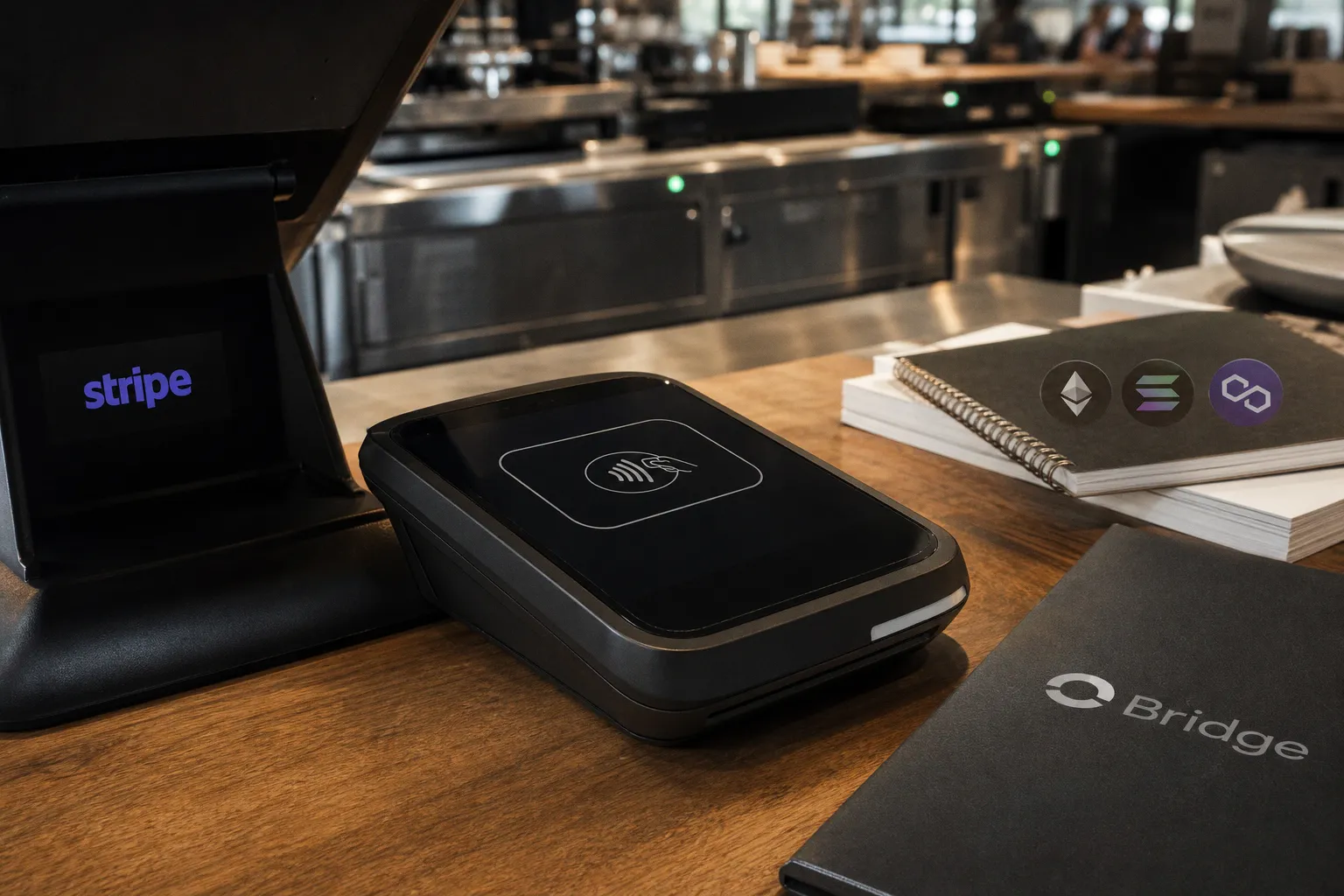
The choice to support three chains rather than one is the most informative architectural decision in the integration. A single-chain rail would have been simpler to operate, but it would have inherited that chain's congestion profile, fee regime, and validator risk surface. By supporting Ethereum, Solana, and Polygon in parallel, Stripe has effectively built a multi-rail payment processor in which the merchant — and, more importantly, the orchestration layer beneath the merchant — selects the execution path based on the cost-latency tradeoff of the moment.
The three rails are not interchangeable. They differ along four engineering axes: finality latency, per-transaction fee, throughput, and settlement guarantee. The table below maps the relevant parameters.
| Parameter | Ethereum (L1) | Solana | Polygon |
|---|---|---|---|
| Finality (deterministic) | ~12 minutes | ~2–5 seconds | ~5–10 seconds (PoS finality) |
| Typical USDC transfer fee | $0.50–$3.00 | $0.0001–$0.001 | <$0.01 |
| Effective throughput | ~15–30 TPS | ~2,000–4,000 TPS | ~1,000–7,000 TPS |
| Settlement guarantee | Cryptoeconomic (validator slashing) | Cryptoeconomic | Cryptoeconomic + checkpointed to Ethereum |
The if-then logic at the application layer is straightforward. For a low-ticket consumer purchase, the orchestration layer routes to Polygon or Solana, where fees are negligible and finality is measured in seconds. For a high-value B2B settlement, the orchestration layer routes to Ethereum, where the cryptoeconomic security budget is the deepest in the industry. The merchant does not see this routing decision; it is a backend optimization performed by Stripe and, increasingly, by the Bridge primitives acquired in October.
It is worth flagging a structural point. The current integration supports USDC specifically, not a generalized basket of stablecoins. This is not a marketing limitation; it is a technical one. USDC has regulated reserve attestations, a transparent mint/burn mechanism, and a uniform contract address across all three supported chains. Adding USDT or a yield-bearing variant would require a parallel reserve-management workflow, parallel compliance screening, and a parallel oracle stack for the peg. The single-asset corridor is the simplest version of the machine that still works.
The Bridge Acquisition: Scaling Stablecoin Settlement Capabilities
The $1.1 billion acquisition of Bridge, executed in October 2024, is the second leg of the architecture. Bridge is not a payment processor in the conventional sense; it is a stablecoin orchestration layer that abstracts chain selection, gas sponsorship, and merchant off-ramping into a single API. In protocol-engineering terms, Bridge is the abstraction that lets a merchant treat stablecoin settlement as if it were a single rail, even though the underlying execution is a multi-chain fan-out.
The technical capabilities Bridge brings to the integration are fourfold. First, it handles gas abstraction, allowing the merchant or the customer to pay transaction fees in USDC rather than in the native gas token of the chosen chain. This eliminates the friction of holding a chain-specific token in the customer's wallet and is a precondition for true consumer-grade UX. Second, it manages cross-chain liquidity routing, moving USDC between chains to ensure that the off-ramp partner has sufficient inventory to execute a fiat conversion on demand. Third, it wraps the mint/burn mechanics of the underlying stablecoin in compliance and sanctions-screening logic, which is the difference between a working payment system and a sanctioned one. Fourth, it provides a unified ledger view to Stripe, so that settlement accounting is identical regardless of which execution chain processed the payment.
The strategic logic of the acquisition is, in effect, an outsourcing of the orchestration problem. Stripe could have built these primitives in-house, but doing so would have required multi-year engineering investment in chain-specific integrations, liquidity partnerships, and a compliance pipeline. Buying Bridge compresses that timeline to a single quarter of post-acquisition integration. The $1.1 billion price tag, in that frame, is the cost of buying a working orchestration stack rather than building one.
Bridge is not a payment processor; it is the abstraction layer that lets a merchant ignore the chain entirely. The acquisition is a buy-versus-build decision executed at a market-clearing price.
There is a second-order consequence worth naming. By owning Bridge, Stripe internalizes the routing decision. The orchestration layer can be tuned to optimize for Stripe's own settlement economics — minimizing conversion slippage, prioritizing chains with the deepest USDC liquidity, and routing around chains that are experiencing fee spikes. This is the equivalent of an enterprise payment processor owning its own acquirer: it gives Stripe vertical control over the entire cost structure.
Frictionless Checkout: The USDC-to-Fiat Conversion Loop
The merchant-facing UX is the part of the system that the public sees, and it is the part that has been most carefully abstracted. The customer, in the default flow, does not interact with a blockchain directly. They see a "Pay with Crypto" option at checkout, select it, connect a wallet, and authorize a USDC transfer on one of the three supported chains. From the customer's perspective, the transaction completes in seconds. From the merchant's perspective, the funds arrive as USD in their bank account, not as USDC in a custodial wallet. The volatility risk, the chain selection, and the gas payment have all been pushed down a layer into the orchestration stack.
The if-then logic in the conversion loop branches on the merchant's settlement preference. If the merchant selects fiat settlement — the default path — Stripe's off-ramp partner converts the USDC to USD at near-parity and initiates a standard ACH or card-network settlement to the merchant's bank account. The conversion happens at the moment of capture, locking in the USD revenue figure. If the merchant selects crypto-native settlement, the USDC is delivered to a custodial or self-custodial wallet designated by the merchant, and the volatility risk transfers from Stripe to the merchant. Both paths are technically supported, but the fiat default is the dominant one, and the engineering effort has gone into making that path as close to a card-network experience as possible.
Three specific frictions are worth naming. The first is fee transparency. Card networks charge interchange, assessment, and processor fees that typically sum to 2.5–3.5% of the transaction. The current stablecoin checkout does not publish a comparable fee schedule, and the total cost to the merchant depends on the chain selected, the gas market at the moment of execution, and the spread captured by the off-ramp. The second is refund mechanics. A card refund is a familiar, well-engineered flow; a stablecoin refund requires the merchant to hold an inventory of USDC on the destination chain, or to initiate a fresh mint through Bridge. The third is reconciliation. Card networks return ISO 8583 messages with a uniform settlement format; stablecoin settlements return on-chain transaction hashes that must be matched to internal order IDs through a separate reconciliation layer.
These three frictions define the engineering work that remains before stablecoin checkout is a drop-in replacement for card acceptance. They are not deal-breakers, but they are real, and they are the constraints that will determine the speed of merchant adoption.
Adoption Outlook, Cross-Border Logic, and Stress-Test Vulnerabilities
The model, taken as a whole, has a specific failure surface, and naming it is part of an honest assessment. There are four stress-test scenarios that a systems engineer should run before treating the rail as production-grade, and a fifth axis — cross-border settlement — that defines the long-term growth thesis.
The first scenario is a peg failure. USDC's peg has held through multiple stress events — the March 2023 SVB unwind, the August 2023 Curve exit — but it is a peg, not a guarantee. If Circle's reserves were to become impaired in a way that broke the arbitrage loop, the conversion from USDC to USD would no longer be near-parity, and the entire settlement flow would inherit that slippage. Stripe's mitigation is the off-ramp partner's reserve buffer and the speed of the conversion, neither of which is fully transparent in the public documentation.
The second scenario is a chain-specific outage. Solana has experienced multiple multi-hour outages in its mainnet history. If the orchestration layer routed a large fraction of traffic to Solana at the moment of an outage, the settlement flow would back up, and the merchant would experience the same latency problem that killed the 2014 Bitcoin integration. The mitigation is the multi-chain architecture itself, but only if Bridge is sophisticated enough to detect the outage and reroute in real time.
The third scenario is regulatory intervention. The current U.S. merchant focus is, in part, a regulatory scoping decision. Expanding the rail to other jurisdictions requires navigating a patchwork of stablecoin licensing regimes, and a sudden enforcement action against a specific chain or stablecoin issuer would force an immediate and potentially costly reconfiguration of the supported asset set. The integration's exposure to a single stablecoin and a single primary issuer is, in this sense, a concentration risk.
The fourth scenario is settlement finality assumptions. On chains with probabilistic finality or short reorg windows, a payment that appears settled can in principle be reversed. The current integration treats Solana and Polygon finality as deterministic, which is true in practice but not in the strictest cryptographic sense. A sufficiently deep reorganization — a low-probability, high-impact event — would invalidate settled transactions and force a manual reversal process.
The cross-border logic, in turn, is where the model has its most credible long-term growth thesis. Card-network cross-border settlements are routed through correspondent banks, take two to five business days to clear, and absorb 3–7% in cumulative fees from interchange, FX spread, and intermediary charges. A stablecoin rail collapses that stack into a single on-chain transfer and a single fiat off-ramp at the destination, with a finality measured in seconds rather than days. The current U.S.-merchant focus delays this thesis, but it does not invalidate it; the engineering primitives are already in place to support a cross-border expansion once the regulatory and banking-partner plumbing is completed.
The strategic read is straightforward. Stripe has converted stablecoin payments from a retail crypto-native flow into an enterprise-grade payment rail by outsourcing the orchestration problem to Bridge, constraining the asset set to a single regulated stablecoin, and terminating settlement in fiat by default. The result is a system that looks, to the merchant, like a card-network integration with faster settlement, and that looks, to the engineer, like a multi-chain execution layer with a fiat off-ramp. The two views are not in tension; they are the same machine observed from different altitudes. The remaining work — fee transparency, refund mechanics, reconciliation parity, stress-test hardening, and cross-border licensing — is execution, not redesign, and that is the most important signal in the October 2024 release.